French vs Australian Married-Couple Family Poverty
COMPARE
French
Australian
Married-Couple Family Poverty
Married-Couple Family Poverty Comparison
French
Australians
4.3%
MARRIED-COUPLE FAMILY POVERTY
99.7/ 100
METRIC RATING
55th/ 347
METRIC RANK
4.3%
MARRIED-COUPLE FAMILY POVERTY
99.7/ 100
METRIC RATING
48th/ 347
METRIC RANK
French vs Australian Married-Couple Family Poverty Correlation Chart
The statistical analysis conducted on geographies consisting of 557,631,168 people shows a moderate positive correlation between the proportion of French and poverty level among married-couple families in the United States with a correlation coefficient (R) of 0.425 and weighted average of 4.3%. Similarly, the statistical analysis conducted on geographies consisting of 222,779,850 people shows a very strong positive correlation between the proportion of Australians and poverty level among married-couple families in the United States with a correlation coefficient (R) of 0.805 and weighted average of 4.3%, a difference of 0.66%.
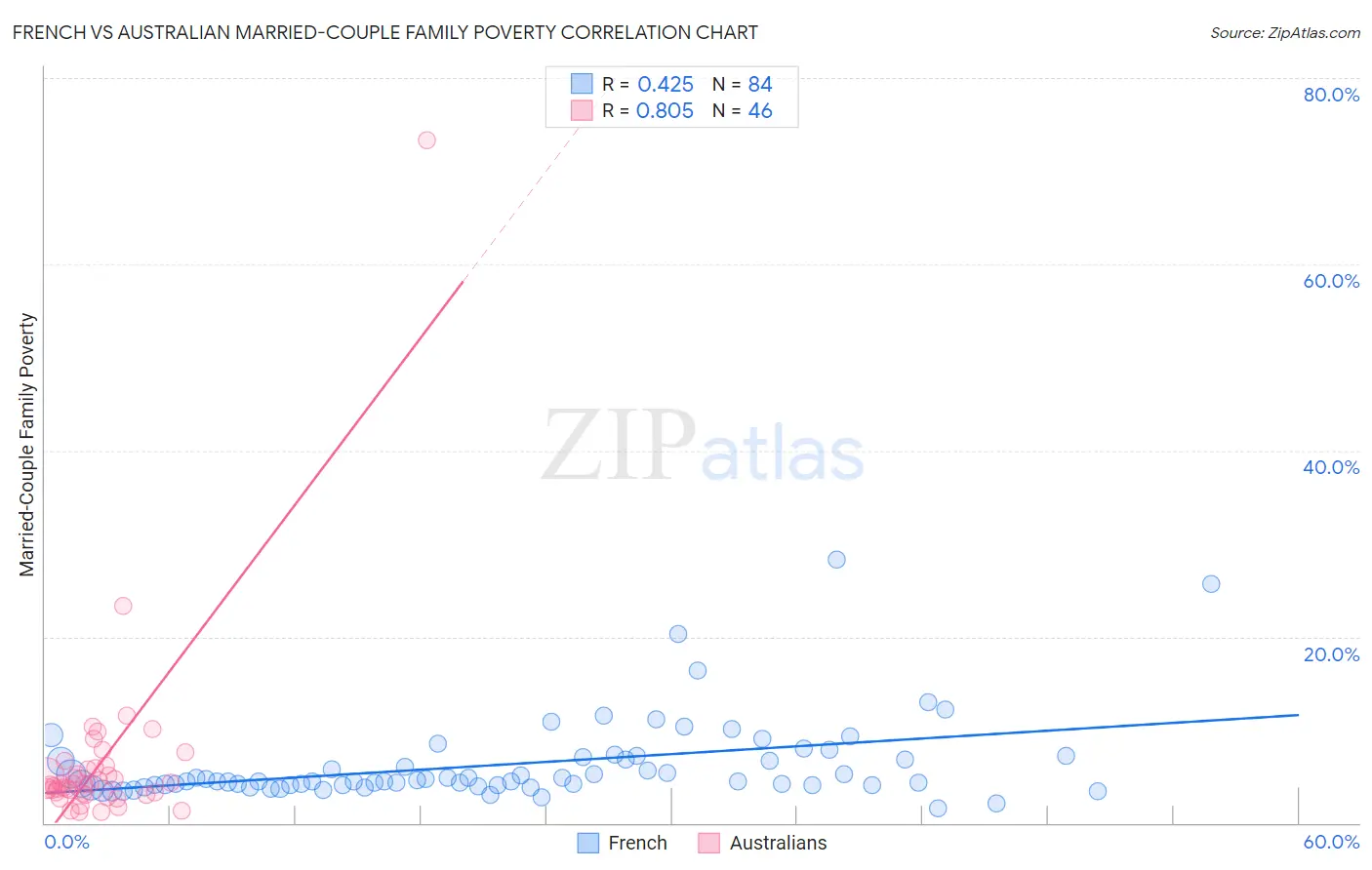
Married-Couple Family Poverty Correlation Summary
| Measurement | French | Australian |
| Minimum | 1.6% | 1.1% |
| Maximum | 28.3% | 73.3% |
| Range | 26.7% | 72.2% |
| Mean | 6.3% | 6.5% |
| Median | 4.5% | 4.1% |
| Interquartile 25% (IQ1) | 4.0% | 3.2% |
| Interquartile 75% (IQ3) | 6.9% | 5.9% |
| Interquartile Range (IQR) | 2.9% | 2.7% |
| Standard Deviation (Sample) | 4.5% | 10.7% |
| Standard Deviation (Population) | 4.5% | 10.6% |
Demographics Similar to French and Australians by Married-Couple Family Poverty
In terms of married-couple family poverty, the demographic groups most similar to French are Austrian (4.3%, a difference of 0.020%), Immigrants from Zimbabwe (4.3%, a difference of 0.16%), Immigrants from Netherlands (4.3%, a difference of 0.16%), Czechoslovakian (4.4%, a difference of 0.24%), and Welsh (4.3%, a difference of 0.29%). Similarly, the demographic groups most similar to Australians are Immigrants from South Central Asia (4.3%, a difference of 0.070%), Turkish (4.3%, a difference of 0.080%), Burmese (4.3%, a difference of 0.18%), British (4.3%, a difference of 0.19%), and Immigrants from Lithuania (4.3%, a difference of 0.19%).
| Demographics | Rating | Rank | Married-Couple Family Poverty |
| Northern Europeans | 99.8 /100 | #41 | Exceptional 4.3% |
| Scottish | 99.8 /100 | #42 | Exceptional 4.3% |
| Swiss | 99.8 /100 | #43 | Exceptional 4.3% |
| Immigrants | Japan | 99.8 /100 | #44 | Exceptional 4.3% |
| Serbians | 99.8 /100 | #45 | Exceptional 4.3% |
| British | 99.8 /100 | #46 | Exceptional 4.3% |
| Immigrants | South Central Asia | 99.8 /100 | #47 | Exceptional 4.3% |
| Australians | 99.7 /100 | #48 | Exceptional 4.3% |
| Turks | 99.7 /100 | #49 | Exceptional 4.3% |
| Burmese | 99.7 /100 | #50 | Exceptional 4.3% |
| Immigrants | Lithuania | 99.7 /100 | #51 | Exceptional 4.3% |
| Russians | 99.7 /100 | #52 | Exceptional 4.3% |
| Welsh | 99.7 /100 | #53 | Exceptional 4.3% |
| Austrians | 99.7 /100 | #54 | Exceptional 4.3% |
| French | 99.7 /100 | #55 | Exceptional 4.3% |
| Immigrants | Zimbabwe | 99.7 /100 | #56 | Exceptional 4.3% |
| Immigrants | Netherlands | 99.7 /100 | #57 | Exceptional 4.3% |
| Czechoslovakians | 99.7 /100 | #58 | Exceptional 4.4% |
| Immigrants | Sweden | 99.6 /100 | #59 | Exceptional 4.4% |
| Tlingit-Haida | 99.6 /100 | #60 | Exceptional 4.4% |
| Okinawans | 99.6 /100 | #61 | Exceptional 4.4% |