Iroquois vs Immigrants from Western Africa Female Poverty
COMPARE
Iroquois
Immigrants from Western Africa
Female Poverty
Female Poverty Comparison
Iroquois
Immigrants from Western Africa
15.8%
FEMALE POVERTY
0.1/ 100
METRIC RATING
269th/ 347
METRIC RANK
15.3%
FEMALE POVERTY
0.3/ 100
METRIC RATING
250th/ 347
METRIC RANK
Iroquois vs Immigrants from Western Africa Female Poverty Correlation Chart
The statistical analysis conducted on geographies consisting of 207,228,109 people shows a significant positive correlation between the proportion of Iroquois and poverty level among females in the United States with a correlation coefficient (R) of 0.698 and weighted average of 15.8%. Similarly, the statistical analysis conducted on geographies consisting of 357,511,733 people shows a weak positive correlation between the proportion of Immigrants from Western Africa and poverty level among females in the United States with a correlation coefficient (R) of 0.218 and weighted average of 15.3%, a difference of 3.2%.
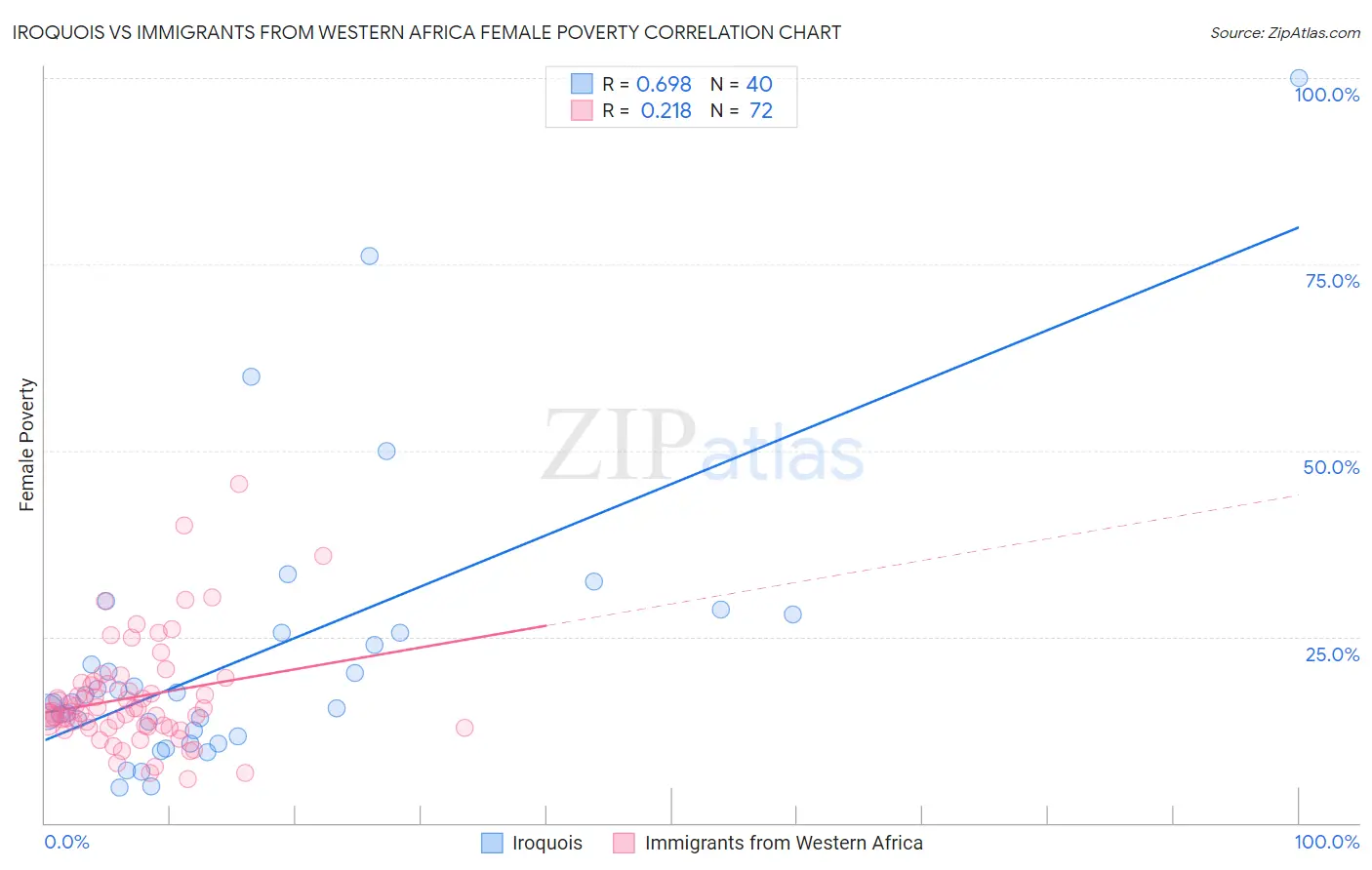
Female Poverty Correlation Summary
| Measurement | Iroquois | Immigrants from Western Africa |
| Minimum | 4.7% | 5.9% |
| Maximum | 100.0% | 45.5% |
| Range | 95.3% | 39.6% |
| Mean | 22.4% | 16.9% |
| Median | 16.7% | 15.1% |
| Interquartile 25% (IQ1) | 12.0% | 12.8% |
| Interquartile 75% (IQ3) | 25.5% | 18.7% |
| Interquartile Range (IQR) | 13.5% | 5.9% |
| Standard Deviation (Sample) | 19.0% | 7.3% |
| Standard Deviation (Population) | 18.8% | 7.2% |
Demographics Similar to Iroquois and Immigrants from Western Africa by Female Poverty
In terms of female poverty, the demographic groups most similar to Iroquois are Immigrants from Nicaragua (15.8%, a difference of 0.37%), Subsaharan African (15.8%, a difference of 0.43%), Immigrants from El Salvador (15.7%, a difference of 0.85%), Immigrants from Liberia (15.7%, a difference of 0.92%), and Immigrants from Ecuador (15.6%, a difference of 1.2%). Similarly, the demographic groups most similar to Immigrants from Western Africa are Salvadoran (15.3%, a difference of 0.040%), Immigrants from Trinidad and Tobago (15.4%, a difference of 0.16%), Immigrants from Burma/Myanmar (15.4%, a difference of 0.19%), Liberian (15.4%, a difference of 0.45%), and Trinidadian and Tobagonian (15.4%, a difference of 0.69%).
| Demographics | Rating | Rank | Female Poverty |
| Salvadorans | 0.3 /100 | #249 | Tragic 15.3% |
| Immigrants | Western Africa | 0.3 /100 | #250 | Tragic 15.3% |
| Immigrants | Trinidad and Tobago | 0.3 /100 | #251 | Tragic 15.4% |
| Immigrants | Burma/Myanmar | 0.3 /100 | #252 | Tragic 15.4% |
| Liberians | 0.2 /100 | #253 | Tragic 15.4% |
| Trinidadians and Tobagonians | 0.2 /100 | #254 | Tragic 15.4% |
| Ottawa | 0.2 /100 | #255 | Tragic 15.5% |
| Jamaicans | 0.2 /100 | #256 | Tragic 15.5% |
| Immigrants | Jamaica | 0.1 /100 | #257 | Tragic 15.6% |
| Shoshone | 0.1 /100 | #258 | Tragic 15.6% |
| Cape Verdeans | 0.1 /100 | #259 | Tragic 15.6% |
| Immigrants | Guyana | 0.1 /100 | #260 | Tragic 15.6% |
| Guyanese | 0.1 /100 | #261 | Tragic 15.6% |
| Mexican American Indians | 0.1 /100 | #262 | Tragic 15.6% |
| Cherokee | 0.1 /100 | #263 | Tragic 15.6% |
| Immigrants | Ecuador | 0.1 /100 | #264 | Tragic 15.6% |
| Immigrants | Liberia | 0.1 /100 | #265 | Tragic 15.7% |
| Immigrants | El Salvador | 0.1 /100 | #266 | Tragic 15.7% |
| Sub-Saharan Africans | 0.1 /100 | #267 | Tragic 15.8% |
| Immigrants | Nicaragua | 0.1 /100 | #268 | Tragic 15.8% |
| Iroquois | 0.1 /100 | #269 | Tragic 15.8% |