Sioux vs Soviet Union Self-Care Disability
COMPARE
Sioux
Soviet Union
Self-Care Disability
Self-Care Disability Comparison
Sioux
Soviet Union
2.5%
SELF-CARE DISABILITY
24.6/ 100
METRIC RATING
190th/ 347
METRIC RANK
2.5%
SELF-CARE DISABILITY
22.2/ 100
METRIC RATING
192nd/ 347
METRIC RANK
Sioux vs Soviet Union Self-Care Disability Correlation Chart
The statistical analysis conducted on geographies consisting of 233,917,854 people shows a poor negative correlation between the proportion of Sioux and percentage of population with self-care disability in the United States with a correlation coefficient (R) of -0.148 and weighted average of 2.5%. Similarly, the statistical analysis conducted on geographies consisting of 43,492,822 people shows no correlation between the proportion of Soviet Union and percentage of population with self-care disability in the United States with a correlation coefficient (R) of 0.006 and weighted average of 2.5%, a difference of 0.16%.
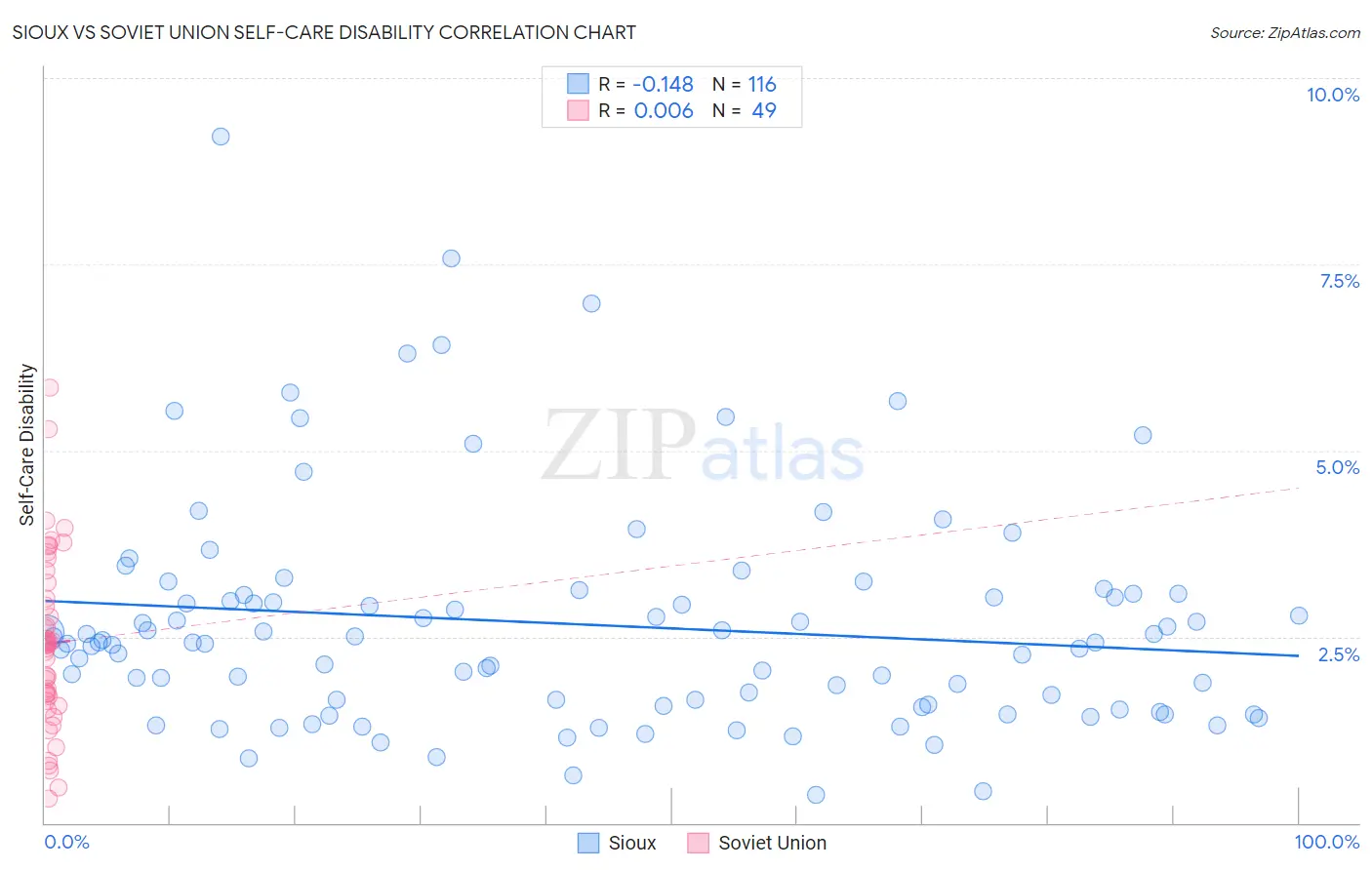
Self-Care Disability Correlation Summary
| Measurement | Sioux | Soviet Union |
| Minimum | 0.38% | 0.32% |
| Maximum | 9.2% | 5.8% |
| Range | 8.8% | 5.5% |
| Mean | 2.7% | 2.4% |
| Median | 2.4% | 2.4% |
| Interquartile 25% (IQ1) | 1.6% | 1.7% |
| Interquartile 75% (IQ3) | 3.1% | 3.1% |
| Interquartile Range (IQR) | 1.5% | 1.5% |
| Standard Deviation (Sample) | 1.5% | 1.2% |
| Standard Deviation (Population) | 1.5% | 1.1% |
Demographics Similar to Sioux and Soviet Union by Self-Care Disability
In terms of self-care disability, the demographic groups most similar to Sioux are Moroccan (2.5%, a difference of 0.11%), Immigrants from Eastern Europe (2.5%, a difference of 0.21%), Immigrants from Oceania (2.5%, a difference of 0.22%), Ukrainian (2.5%, a difference of 0.22%), and Irish (2.5%, a difference of 0.25%). Similarly, the demographic groups most similar to Soviet Union are Moroccan (2.5%, a difference of 0.050%), Ukrainian (2.5%, a difference of 0.060%), Immigrants from Germany (2.5%, a difference of 0.32%), Immigrants from Eastern Europe (2.5%, a difference of 0.36%), and Immigrants from Oceania (2.5%, a difference of 0.38%).
| Demographics | Rating | Rank | Self-Care Disability |
| Ghanaians | 40.4 /100 | #181 | Average 2.5% |
| Maltese | 37.5 /100 | #182 | Fair 2.5% |
| Salvadorans | 36.4 /100 | #183 | Fair 2.5% |
| Yugoslavians | 36.1 /100 | #184 | Fair 2.5% |
| Slavs | 34.3 /100 | #185 | Fair 2.5% |
| Immigrants | El Salvador | 33.0 /100 | #186 | Fair 2.5% |
| Irish | 28.7 /100 | #187 | Fair 2.5% |
| Immigrants | Oceania | 28.3 /100 | #188 | Fair 2.5% |
| Immigrants | Eastern Europe | 28.0 /100 | #189 | Fair 2.5% |
| Sioux | 24.6 /100 | #190 | Fair 2.5% |
| Moroccans | 22.9 /100 | #191 | Fair 2.5% |
| Soviet Union | 22.2 /100 | #192 | Fair 2.5% |
| Ukrainians | 21.4 /100 | #193 | Fair 2.5% |
| Immigrants | Germany | 17.9 /100 | #194 | Poor 2.5% |
| Immigrants | Southern Europe | 15.6 /100 | #195 | Poor 2.5% |
| Koreans | 15.5 /100 | #196 | Poor 2.5% |
| Crow | 15.2 /100 | #197 | Poor 2.5% |
| Immigrants | Immigrants | 15.0 /100 | #198 | Poor 2.5% |
| Immigrants | Ghana | 14.7 /100 | #199 | Poor 2.5% |
| Immigrants | Western Africa | 13.3 /100 | #200 | Poor 2.5% |
| Immigrants | South Eastern Asia | 12.9 /100 | #201 | Poor 2.5% |