Pakistani vs German Russian Unemployment Among Women with Children Ages 6 to 17 years
COMPARE
Pakistani
German Russian
Unemployment Among Women with Children Ages 6 to 17 years
Unemployment Among Women with Children Ages 6 to 17 years Comparison
Pakistanis
German Russians
8.4%
UNEMPLOYMENT AMONG WOMEN WITH CHILDREN AGES 6 TO 17 YEARS
99.6/ 100
METRIC RATING
78th/ 347
METRIC RANK
8.5%
UNEMPLOYMENT AMONG WOMEN WITH CHILDREN AGES 6 TO 17 YEARS
98.6/ 100
METRIC RATING
96th/ 347
METRIC RANK
Pakistani vs German Russian Unemployment Among Women with Children Ages 6 to 17 years Correlation Chart
The statistical analysis conducted on geographies consisting of 251,939,876 people shows a very strong positive correlation between the proportion of Pakistanis and unemployment rate among women with children between the ages 6 and 17 in the United States with a correlation coefficient (R) of 0.810 and weighted average of 8.4%. Similarly, the statistical analysis conducted on geographies consisting of 84,307,306 people shows a very strong positive correlation between the proportion of German Russians and unemployment rate among women with children between the ages 6 and 17 in the United States with a correlation coefficient (R) of 0.800 and weighted average of 8.5%, a difference of 1.6%.
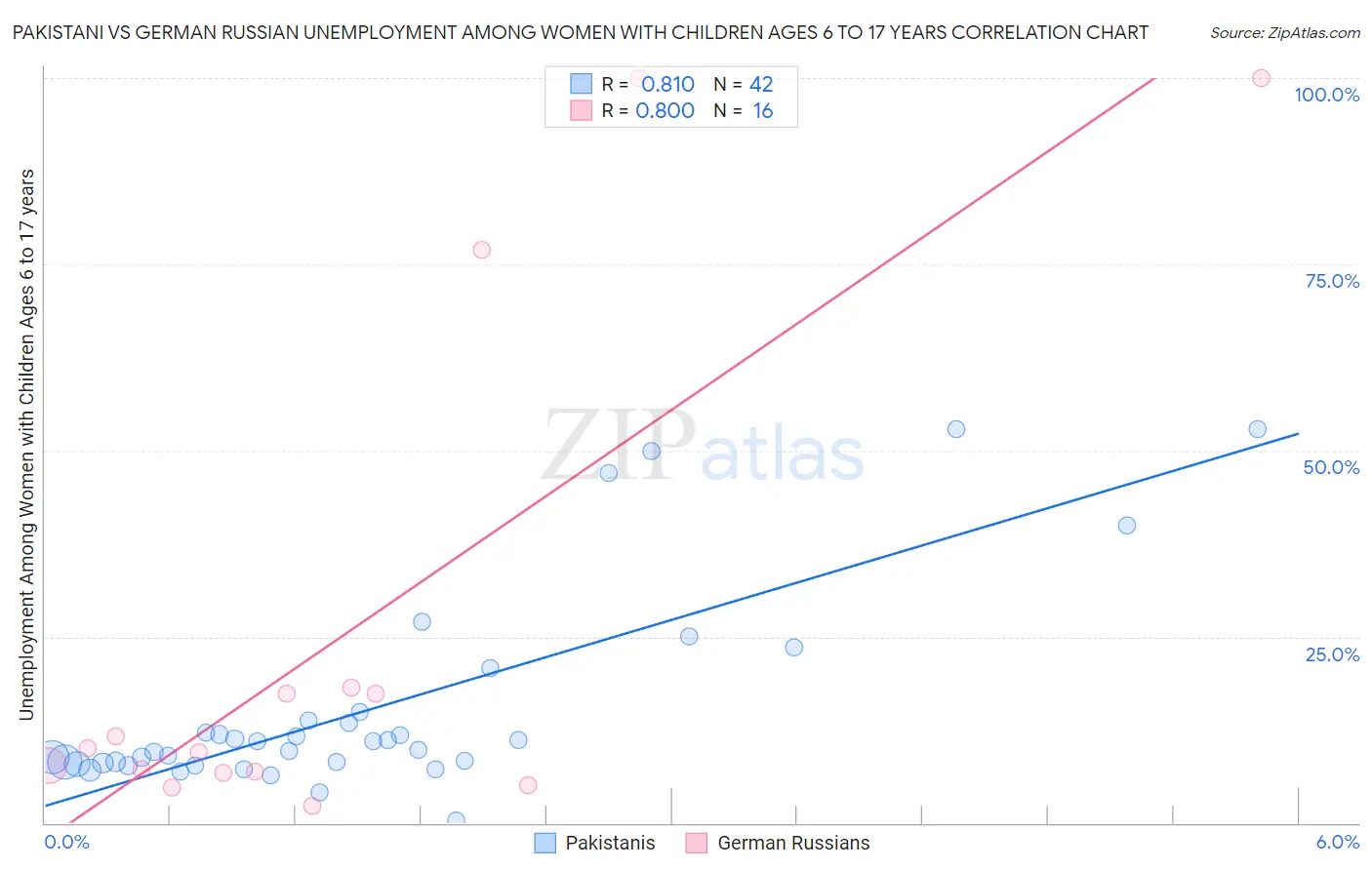
Unemployment Among Women with Children Ages 6 to 17 years Correlation Summary
| Measurement | Pakistani | German Russian |
| Minimum | 0.40% | 2.3% |
| Maximum | 52.8% | 100.0% |
| Range | 52.4% | 97.7% |
| Mean | 15.3% | 25.1% |
| Median | 10.4% | 9.8% |
| Interquartile 25% (IQ1) | 8.0% | 6.8% |
| Interquartile 75% (IQ3) | 13.8% | 17.8% |
| Interquartile Range (IQR) | 5.8% | 11.0% |
| Standard Deviation (Sample) | 13.5% | 34.0% |
| Standard Deviation (Population) | 13.3% | 32.9% |
Demographics Similar to Pakistanis and German Russians by Unemployment Among Women with Children Ages 6 to 17 years
In terms of unemployment among women with children ages 6 to 17 years, the demographic groups most similar to Pakistanis are Mongolian (8.4%, a difference of 0.010%), Immigrants from Belarus (8.4%, a difference of 0.050%), Iraqi (8.4%, a difference of 0.14%), Immigrants from Bolivia (8.4%, a difference of 0.17%), and Cypriot (8.4%, a difference of 0.19%). Similarly, the demographic groups most similar to German Russians are Sri Lankan (8.5%, a difference of 0.070%), Bolivian (8.5%, a difference of 0.090%), Immigrants from Barbados (8.5%, a difference of 0.12%), Australian (8.5%, a difference of 0.23%), and Potawatomi (8.5%, a difference of 0.35%).
| Demographics | Rating | Rank | Unemployment Among Women with Children Ages 6 to 17 years |
| Iraqis | 99.7 /100 | #77 | Exceptional 8.4% |
| Pakistanis | 99.6 /100 | #78 | Exceptional 8.4% |
| Mongolians | 99.6 /100 | #79 | Exceptional 8.4% |
| Immigrants | Belarus | 99.6 /100 | #80 | Exceptional 8.4% |
| Immigrants | Bolivia | 99.6 /100 | #81 | Exceptional 8.4% |
| Cypriots | 99.6 /100 | #82 | Exceptional 8.4% |
| Bulgarians | 99.5 /100 | #83 | Exceptional 8.4% |
| Japanese | 99.5 /100 | #84 | Exceptional 8.4% |
| Immigrants | North Macedonia | 99.4 /100 | #85 | Exceptional 8.5% |
| Alaskan Athabascans | 99.4 /100 | #86 | Exceptional 8.5% |
| Immigrants | Israel | 99.1 /100 | #87 | Exceptional 8.5% |
| Immigrants | Vietnam | 99.1 /100 | #88 | Exceptional 8.5% |
| Paiute | 99.1 /100 | #89 | Exceptional 8.5% |
| Yugoslavians | 99.0 /100 | #90 | Exceptional 8.5% |
| Immigrants | Eastern Europe | 99.0 /100 | #91 | Exceptional 8.5% |
| Potawatomi | 99.0 /100 | #92 | Exceptional 8.5% |
| Australians | 98.9 /100 | #93 | Exceptional 8.5% |
| Immigrants | Barbados | 98.8 /100 | #94 | Exceptional 8.5% |
| Sri Lankans | 98.7 /100 | #95 | Exceptional 8.5% |
| German Russians | 98.6 /100 | #96 | Exceptional 8.5% |
| Bolivians | 98.5 /100 | #97 | Exceptional 8.5% |