Chickasaw vs Yugoslavian Unemployment Among Women with Children Ages 6 to 17 years
COMPARE
Chickasaw
Yugoslavian
Unemployment Among Women with Children Ages 6 to 17 years
Unemployment Among Women with Children Ages 6 to 17 years Comparison
Chickasaw
Yugoslavians
8.6%
UNEMPLOYMENT AMONG WOMEN WITH CHILDREN AGES 6 TO 17 YEARS
97.6/ 100
METRIC RATING
107th/ 347
METRIC RANK
8.5%
UNEMPLOYMENT AMONG WOMEN WITH CHILDREN AGES 6 TO 17 YEARS
99.0/ 100
METRIC RATING
90th/ 347
METRIC RANK
Chickasaw vs Yugoslavian Unemployment Among Women with Children Ages 6 to 17 years Correlation Chart
The statistical analysis conducted on geographies consisting of 124,393,845 people shows a mild positive correlation between the proportion of Chickasaw and unemployment rate among women with children between the ages 6 and 17 in the United States with a correlation coefficient (R) of 0.343 and weighted average of 8.6%. Similarly, the statistical analysis conducted on geographies consisting of 213,370,013 people shows no correlation between the proportion of Yugoslavians and unemployment rate among women with children between the ages 6 and 17 in the United States with a correlation coefficient (R) of -0.049 and weighted average of 8.5%, a difference of 1.1%.
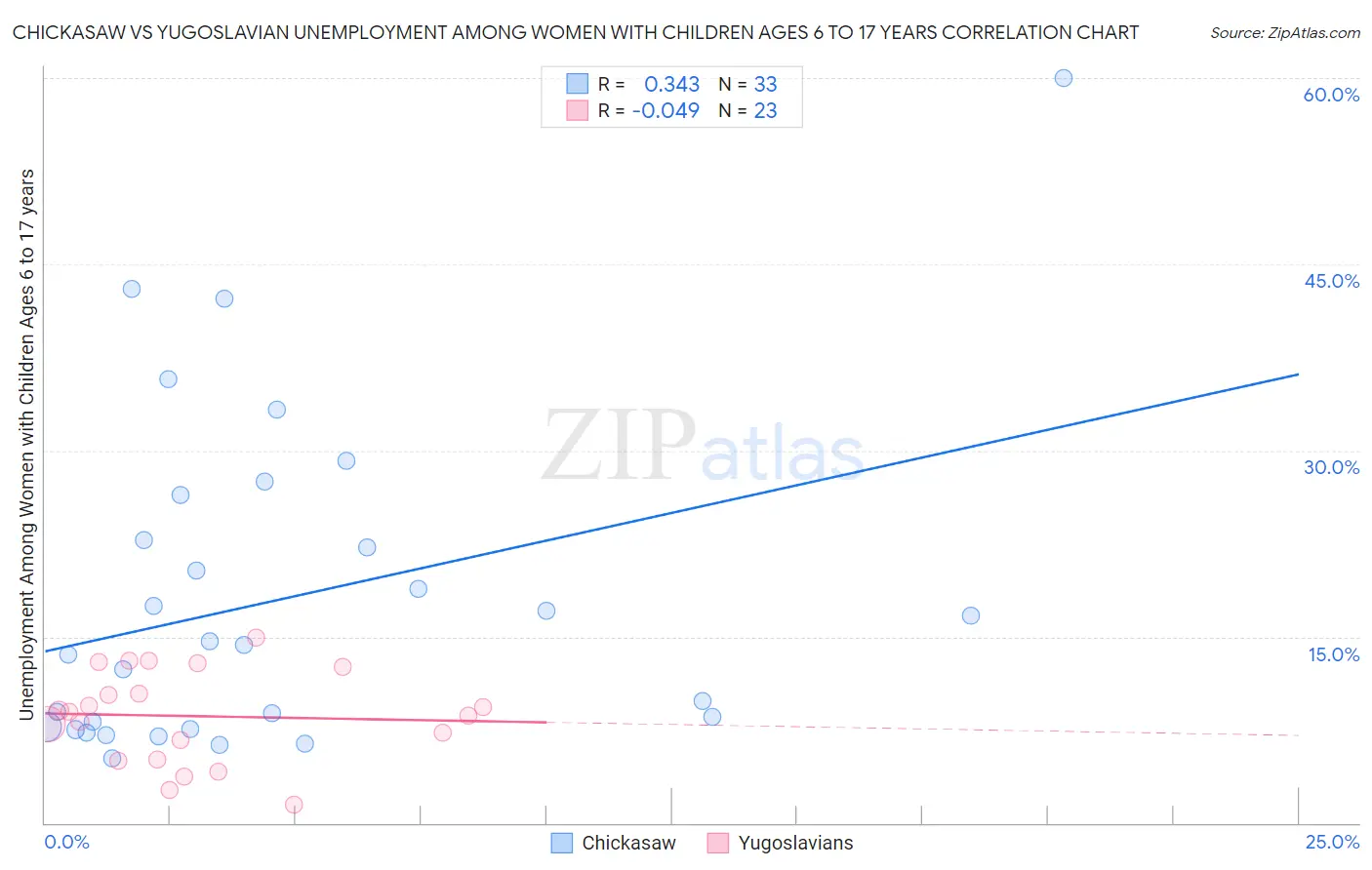
Unemployment Among Women with Children Ages 6 to 17 years Correlation Summary
| Measurement | Chickasaw | Yugoslavian |
| Minimum | 5.2% | 1.5% |
| Maximum | 60.0% | 14.9% |
| Range | 54.8% | 13.4% |
| Mean | 18.0% | 8.6% |
| Median | 14.3% | 9.0% |
| Interquartile 25% (IQ1) | 7.6% | 5.1% |
| Interquartile 75% (IQ3) | 24.6% | 12.6% |
| Interquartile Range (IQR) | 17.0% | 7.5% |
| Standard Deviation (Sample) | 13.1% | 3.7% |
| Standard Deviation (Population) | 12.9% | 3.6% |
Demographics Similar to Chickasaw and Yugoslavians by Unemployment Among Women with Children Ages 6 to 17 years
In terms of unemployment among women with children ages 6 to 17 years, the demographic groups most similar to Chickasaw are Swedish (8.6%, a difference of 0.010%), Immigrants from Serbia (8.6%, a difference of 0.030%), Immigrants from Norway (8.6%, a difference of 0.070%), Immigrants from France (8.6%, a difference of 0.22%), and Scandinavian (8.6%, a difference of 0.40%). Similarly, the demographic groups most similar to Yugoslavians are Paiute (8.5%, a difference of 0.040%), Immigrants from Eastern Europe (8.5%, a difference of 0.060%), Potawatomi (8.5%, a difference of 0.090%), Immigrants from Vietnam (8.5%, a difference of 0.12%), and Australian (8.5%, a difference of 0.21%).
| Demographics | Rating | Rank | Unemployment Among Women with Children Ages 6 to 17 years |
| Immigrants | Vietnam | 99.1 /100 | #88 | Exceptional 8.5% |
| Paiute | 99.1 /100 | #89 | Exceptional 8.5% |
| Yugoslavians | 99.0 /100 | #90 | Exceptional 8.5% |
| Immigrants | Eastern Europe | 99.0 /100 | #91 | Exceptional 8.5% |
| Potawatomi | 99.0 /100 | #92 | Exceptional 8.5% |
| Australians | 98.9 /100 | #93 | Exceptional 8.5% |
| Immigrants | Barbados | 98.8 /100 | #94 | Exceptional 8.5% |
| Sri Lankans | 98.7 /100 | #95 | Exceptional 8.5% |
| German Russians | 98.6 /100 | #96 | Exceptional 8.5% |
| Bolivians | 98.5 /100 | #97 | Exceptional 8.5% |
| Malaysians | 98.5 /100 | #98 | Exceptional 8.6% |
| Immigrants | Lithuania | 98.4 /100 | #99 | Exceptional 8.6% |
| New Zealanders | 98.4 /100 | #100 | Exceptional 8.6% |
| Immigrants | Pakistan | 98.4 /100 | #101 | Exceptional 8.6% |
| Immigrants | South Africa | 98.3 /100 | #102 | Exceptional 8.6% |
| Scandinavians | 98.3 /100 | #103 | Exceptional 8.6% |
| Immigrants | France | 98.0 /100 | #104 | Exceptional 8.6% |
| Immigrants | Norway | 97.8 /100 | #105 | Exceptional 8.6% |
| Immigrants | Serbia | 97.7 /100 | #106 | Exceptional 8.6% |
| Chickasaw | 97.6 /100 | #107 | Exceptional 8.6% |
| Swedes | 97.6 /100 | #108 | Exceptional 8.6% |