Chinese vs Brazilian Births to Unmarried Women
COMPARE
Chinese
Brazilian
Births to Unmarried Women
Births to Unmarried Women Comparison
Chinese
Brazilians
30.2%
BIRTHS TO UNMARRIED WOMEN
87.1/ 100
METRIC RATING
127th/ 347
METRIC RANK
30.4%
BIRTHS TO UNMARRIED WOMEN
84.8/ 100
METRIC RATING
135th/ 347
METRIC RANK
Chinese vs Brazilian Births to Unmarried Women Correlation Chart
The statistical analysis conducted on geographies consisting of 63,513,648 people shows a substantial positive correlation between the proportion of Chinese and percentage of births to unmarried women in the United States with a correlation coefficient (R) of 0.522 and weighted average of 30.2%. Similarly, the statistical analysis conducted on geographies consisting of 304,585,920 people shows no correlation between the proportion of Brazilians and percentage of births to unmarried women in the United States with a correlation coefficient (R) of -0.008 and weighted average of 30.4%, a difference of 0.47%.
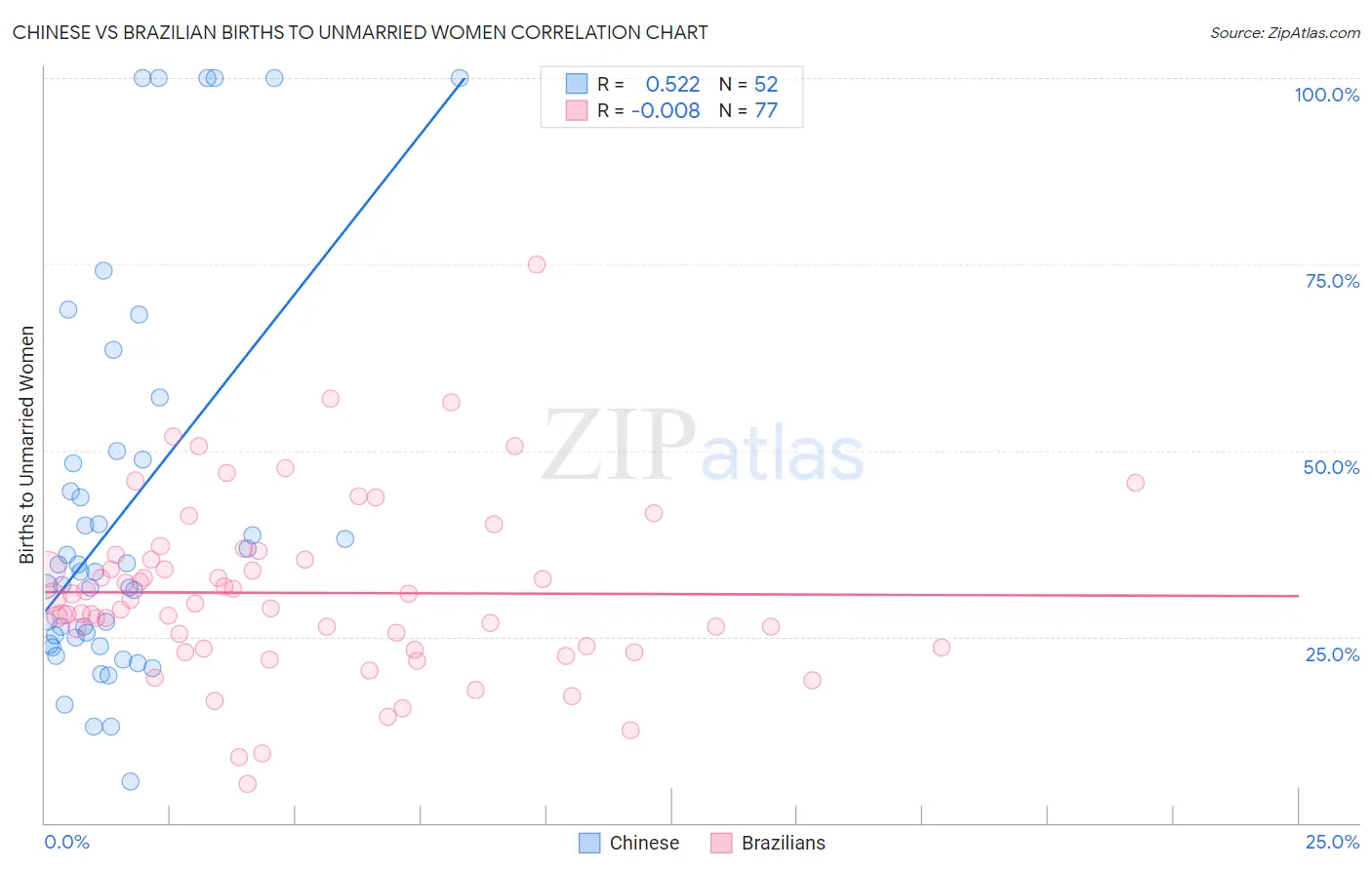
Births to Unmarried Women Correlation Summary
| Measurement | Chinese | Brazilian |
| Minimum | 5.5% | 5.3% |
| Maximum | 100.0% | 74.9% |
| Range | 94.5% | 69.6% |
| Mean | 41.4% | 30.9% |
| Median | 33.7% | 29.4% |
| Interquartile 25% (IQ1) | 24.5% | 23.4% |
| Interquartile 75% (IQ3) | 48.5% | 35.7% |
| Interquartile Range (IQR) | 24.0% | 12.3% |
| Standard Deviation (Sample) | 25.6% | 11.8% |
| Standard Deviation (Population) | 25.4% | 11.7% |
Demographics Similar to Chinese and Brazilians by Births to Unmarried Women
In terms of births to unmarried women, the demographic groups most similar to Chinese are European (30.2%, a difference of 0.030%), Vietnamese (30.2%, a difference of 0.14%), Croatian (30.2%, a difference of 0.22%), Icelander (30.3%, a difference of 0.24%), and Syrian (30.2%, a difference of 0.25%). Similarly, the demographic groups most similar to Brazilians are Immigrants from Scotland (30.4%, a difference of 0.030%), Immigrants from South Eastern Asia (30.4%, a difference of 0.070%), Immigrants from Morocco (30.4%, a difference of 0.080%), New Zealander (30.3%, a difference of 0.13%), and Immigrants from Zimbabwe (30.3%, a difference of 0.16%).
| Demographics | Rating | Rank | Births to Unmarried Women |
| Koreans | 88.9 /100 | #121 | Excellent 30.1% |
| Immigrants | Argentina | 88.7 /100 | #122 | Excellent 30.1% |
| Syrians | 88.2 /100 | #123 | Excellent 30.2% |
| Croatians | 88.0 /100 | #124 | Excellent 30.2% |
| Vietnamese | 87.7 /100 | #125 | Excellent 30.2% |
| Europeans | 87.2 /100 | #126 | Excellent 30.2% |
| Chinese | 87.1 /100 | #127 | Excellent 30.2% |
| Icelanders | 86.0 /100 | #128 | Excellent 30.3% |
| Immigrants | Spain | 85.8 /100 | #129 | Excellent 30.3% |
| Immigrants | Bosnia and Herzegovina | 85.7 /100 | #130 | Excellent 30.3% |
| Immigrants | Zimbabwe | 85.7 /100 | #131 | Excellent 30.3% |
| New Zealanders | 85.5 /100 | #132 | Excellent 30.3% |
| Immigrants | Morocco | 85.2 /100 | #133 | Excellent 30.4% |
| Immigrants | South Eastern Asia | 85.2 /100 | #134 | Excellent 30.4% |
| Brazilians | 84.8 /100 | #135 | Excellent 30.4% |
| Immigrants | Scotland | 84.6 /100 | #136 | Excellent 30.4% |
| Immigrants | Philippines | 83.9 /100 | #137 | Excellent 30.4% |
| Puget Sound Salish | 83.9 /100 | #138 | Excellent 30.4% |
| Immigrants | Canada | 83.7 /100 | #139 | Excellent 30.4% |
| Swiss | 83.1 /100 | #140 | Excellent 30.5% |
| Pakistanis | 83.0 /100 | #141 | Excellent 30.5% |