Pennsylvania German vs Immigrants from Eastern Europe Cognitive Disability
COMPARE
Pennsylvania German
Immigrants from Eastern Europe
Cognitive Disability
Cognitive Disability Comparison
Pennsylvania Germans
Immigrants from Eastern Europe
16.6%
COGNITIVE DISABILITY
99.7/ 100
METRIC RATING
58th/ 347
METRIC RANK
16.5%
COGNITIVE DISABILITY
99.9/ 100
METRIC RATING
38th/ 347
METRIC RANK
Pennsylvania German vs Immigrants from Eastern Europe Cognitive Disability Correlation Chart
The statistical analysis conducted on geographies consisting of 234,106,123 people shows a substantial positive correlation between the proportion of Pennsylvania Germans and percentage of population with cognitive disability in the United States with a correlation coefficient (R) of 0.585 and weighted average of 16.6%. Similarly, the statistical analysis conducted on geographies consisting of 475,806,122 people shows a weak negative correlation between the proportion of Immigrants from Eastern Europe and percentage of population with cognitive disability in the United States with a correlation coefficient (R) of -0.224 and weighted average of 16.5%, a difference of 0.74%.
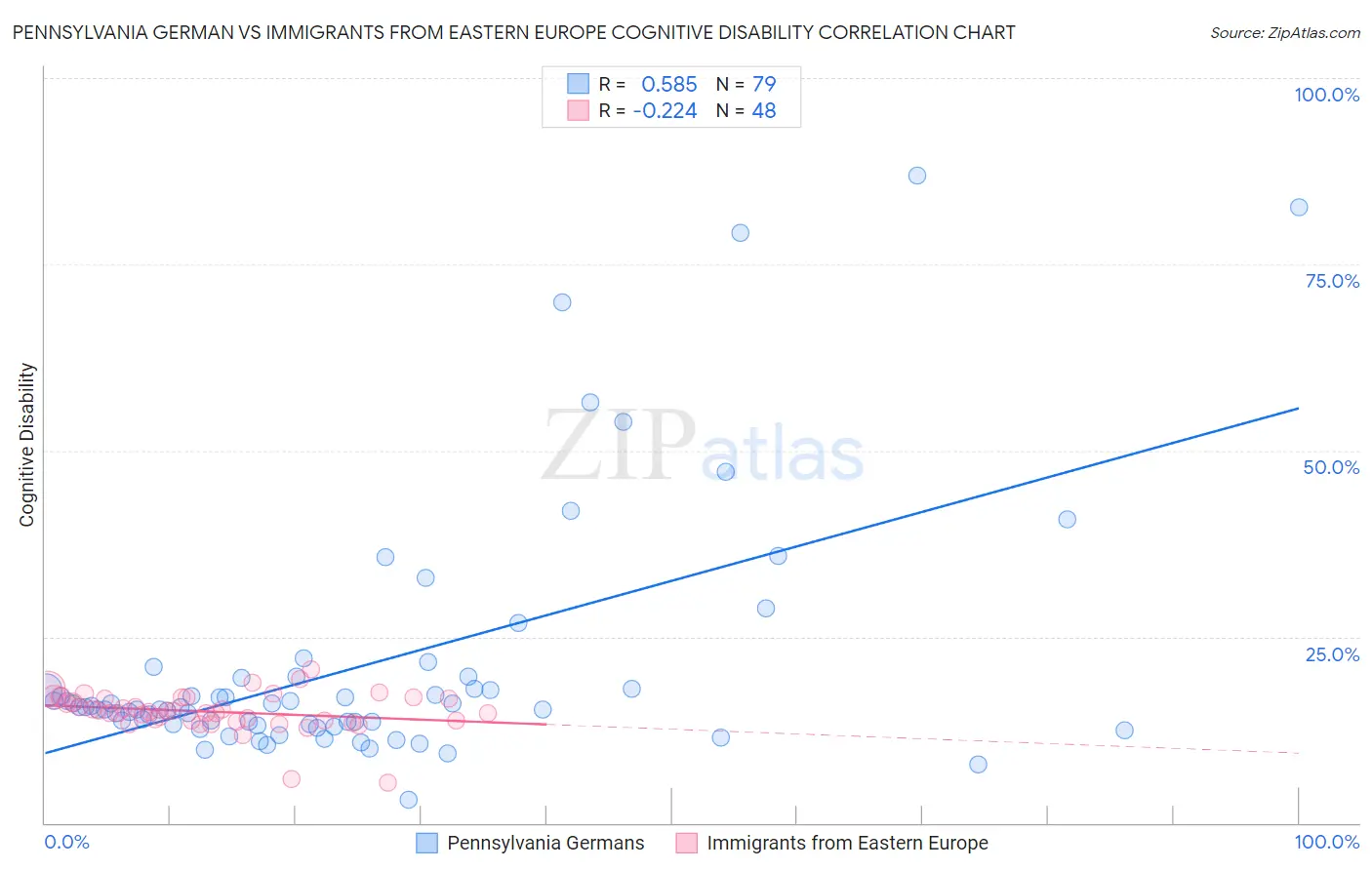
Cognitive Disability Correlation Summary
| Measurement | Pennsylvania German | Immigrants from Eastern Europe |
| Minimum | 3.1% | 5.5% |
| Maximum | 87.0% | 20.6% |
| Range | 83.8% | 15.1% |
| Mean | 21.1% | 14.9% |
| Median | 15.5% | 14.9% |
| Interquartile 25% (IQ1) | 13.2% | 13.8% |
| Interquartile 75% (IQ3) | 19.5% | 16.8% |
| Interquartile Range (IQR) | 6.3% | 3.0% |
| Standard Deviation (Sample) | 16.7% | 2.7% |
| Standard Deviation (Population) | 16.6% | 2.6% |
Demographics Similar to Pennsylvania Germans and Immigrants from Eastern Europe by Cognitive Disability
In terms of cognitive disability, the demographic groups most similar to Pennsylvania Germans are Austrian (16.6%, a difference of 0.080%), Bhutanese (16.6%, a difference of 0.080%), Immigrants from Venezuela (16.5%, a difference of 0.17%), Immigrants from Iran (16.5%, a difference of 0.26%), and Swedish (16.5%, a difference of 0.31%). Similarly, the demographic groups most similar to Immigrants from Eastern Europe are Bolivian (16.5%, a difference of 0.070%), Immigrants from Belarus (16.5%, a difference of 0.090%), Cuban (16.5%, a difference of 0.090%), Hungarian (16.5%, a difference of 0.10%), and Immigrants from Canada (16.5%, a difference of 0.17%).
| Demographics | Rating | Rank | Cognitive Disability |
| Immigrants | Eastern Europe | 99.9 /100 | #38 | Exceptional 16.5% |
| Bolivians | 99.9 /100 | #39 | Exceptional 16.5% |
| Immigrants | Belarus | 99.9 /100 | #40 | Exceptional 16.5% |
| Cubans | 99.9 /100 | #41 | Exceptional 16.5% |
| Hungarians | 99.9 /100 | #42 | Exceptional 16.5% |
| Immigrants | Canada | 99.8 /100 | #43 | Exceptional 16.5% |
| Macedonians | 99.8 /100 | #44 | Exceptional 16.5% |
| Immigrants | Europe | 99.8 /100 | #45 | Exceptional 16.5% |
| Immigrants | Colombia | 99.8 /100 | #46 | Exceptional 16.5% |
| Immigrants | Italy | 99.8 /100 | #47 | Exceptional 16.5% |
| Immigrants | North America | 99.8 /100 | #48 | Exceptional 16.5% |
| Iranians | 99.8 /100 | #49 | Exceptional 16.5% |
| Norwegians | 99.8 /100 | #50 | Exceptional 16.5% |
| Immigrants | Korea | 99.8 /100 | #51 | Exceptional 16.5% |
| Soviet Union | 99.8 /100 | #52 | Exceptional 16.5% |
| Swedes | 99.8 /100 | #53 | Exceptional 16.5% |
| Immigrants | Iran | 99.8 /100 | #54 | Exceptional 16.5% |
| Immigrants | Venezuela | 99.7 /100 | #55 | Exceptional 16.5% |
| Austrians | 99.7 /100 | #56 | Exceptional 16.6% |
| Bhutanese | 99.7 /100 | #57 | Exceptional 16.6% |
| Pennsylvania Germans | 99.7 /100 | #58 | Exceptional 16.6% |